Close
Scientific Research Context
AOD-9604 is a synthetic peptide fragment derived from the C-terminal region of human growth hormone. It was developed to study metabolic signaling pathways related to lipolysis and fat metabolism without stimulating growth hormone receptor–mediated growth effects. Research interest has focused on metabolic regulation and adipose tissue signaling.
Foundational research can be reviewed via PubMed, including: AOD-9604 and fat metabolism and Growth hormone fragments and lipolysis.
What Is AOD-9604?
At a molecular level, AOD-9604 is a modified peptide fragment representing amino acids 176–191 of human growth hormone. It is utilized in laboratory and clinical research settings for its unique ability to influence metabolic signaling pathways associated with fat metabolism. Crucially, it achieves this without activating the growth-promoting effects or altering insulin sensitivity typically associated with full-length HGH.
How AOD-9604 Works
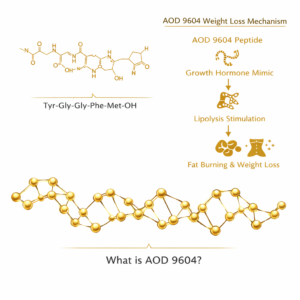
Research suggests that AOD-9604 influences lipid metabolism by modulating two primary pathways:
Stimulation of Lipolysis: The breakdown of existing fat stores.
Inhibition of Lipogenesis: The prevention of new fat accumulation.
Unlike full human growth hormone, evaluating AOD-9604 in research models shows that it does not significantly stimulate IGF-1 (Insulin-like Growth Factor 1) production, making it a highly targeted compound for metabolic studies.
.
In advanced metabolic peptide research, AOD-9604 is rarely studied in isolation. Researchers frequently evaluate its synergistic effects when utilized alongside other metabolic and secretagogue peptides to observe multi-pathway metabolic regulation.
AOD-9604 and Tirzepatide:
Tirzepatide is a dual GIP/GLP-1 receptor agonist primarily studied for its impact on glycemic control and delayed gastric emptying (caloric restriction). When researched alongside AOD-9604, studies observe a multi-pronged approach to metabolic syndrome: Tirzepatide modulates nutrient intake and insulin pathways, while AOD-9604 directly targets the mobilization of lipid stores (lipolysis).
AOD-9604 and CJC-1295:
CJC-1295 is a Growth Hormone Releasing Hormone (GHRH) analogue that stimulates steady, basal endogenous growth hormone levels. Researching these together allows observation of broad systemic recovery and protein synthesis (via CJC-1295) combined with the amplified, targeted fat metabolism of the AOD-9604 fragment, without competing for the same receptor sites.
AOD-9604 and Tesamorelin:
Tesamorelin is another GHRH analogue, but one clinically noted for its specific efficacy in reducing visceral adiposity. Investigating Tesamorelin and AOD-9604 together provides insights into aggressive, localized adipose tissue regulation, comparing visceral fat reduction pathways against generalized lipolysis.
Research-Supported Areas of Study
In preclinical and clinical research models, AOD-9604 has been studied in contexts related to:
• Fat metabolism and lipolysis signaling
• Adipose tissue regulation research
• Metabolic pathway modulation
• Obesity-related research models
• Growth hormone fragment signaling
Onset of Biological Activity and Research Timeframes
Research involving AOD-9604 evaluates metabolic signaling responses over defined observation periods rather than immediate outcomes. Changes in metabolic markers are assessed over weeks in research settings. Individual responses vary based on biological context.
Regulatory and COFEPRIS Context in Mexico
In Mexico, peptides such as AOD-9604 are subject to regulatory oversight depending on formulation and intended use. Professional peptide distribution emphasizes documentation, traceability, and alignment with applicable COFEPRIS requirements. Myosfit operates with COFEPRIS-registered laboratory sourcing and documented quality controls.
Frequently Asked Questions
Is AOD-9604 the same as growth hormone?
No. AOD-9604 is a specific fragment of growth hormone and does not replicate full growth hormone effects.
Is AOD-9604 available in pharmacies in Mexico?
AOD-9604 is not typically sold as an over-the-counter pharmacy medication.
How quickly does AOD-9604 work?
Research focuses on metabolic signaling changes evaluated over defined study periods rather than immediate effects.
Is AOD-9604 approved for medical treatment?
AOD-9604 is not approved as a medical treatment, and research findings do not constitute medical advice.
Selected Scientific References
Ng FM et al. AOD-9604 effects on fat metabolism. PubMedhttps://pubmed.ncbi.nlm.nih.gov/10375108/ https://pubmed.ncbi.nlm.nih.gov/11673763/
Heffernan M et al. Growth hormone fragments and lipolysis. PubMedhttps://pubmed.ncbi.nlm.nih.gov/11225849/ https://pubmed.ncbi.nlm.nih.gov
Walker RF et al. Metabolic effects of GH fragments. PubMedhttps://pubmed.ncbi.nlm.nih.gov/10375107/ https://pubmed.ncbi.nlm.nih.gov/10375107/
Schellekens H et al. Peptide fragments and metabolic regulation. PubMedhttps://pubmed.ncbi.nlm.nih.gov/24040876/ https://pubmed.ncbi.nlm.nih.gov/40526470/