
Close
Glucagon-like peptide-1 (GLP-1)
Is an endogenous incretin hormone naturally produced in the intestines. It is fundamentally involved in glucose metabolism, appetite regulation, and insulin signaling. In clinical and laboratory settings, synthetic GLP-1 receptor agonists have been extensively studied for their profound effects on satiety signaling, glycemic control, and overall energy balance.
Research on GLP-1 pathways spans endocrinology, metabolism, and obesity-related investigation, marking it as one of the most significant areas of modern metabolic study. Key foundational research can be reviewed via PubMed, with primary focuses on the physiology of GLP-1, GLP-1 receptor agonists, and incretin-based therapies
What Are GLP-1 Peptides?
GLP-1 peptides are synthetic analogs designed to mimic or enhance the activity of endogenous GLP-1. Native GLP-1 has a very short half-life in the body, leading researchers to develop longer-acting analogs that resist enzymatic degradation while maintaining receptor-mediated signaling.
How GLP-1 Peptides Work
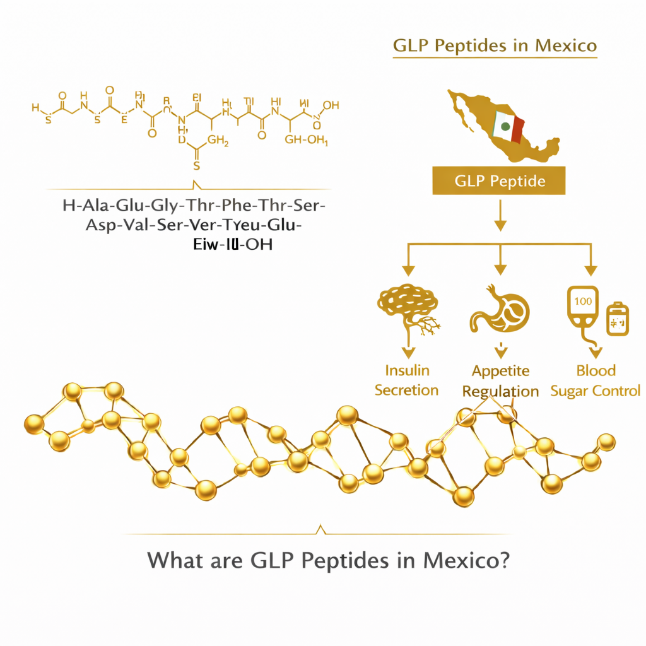
GLP-1 receptor agonists act through receptor-mediated pathways that influence appetite perception, gastric emptying, and glucose-dependent insulin secretion. These effects are regulated centrally and peripherally through gut–brain signaling pathways rather than direct hormone replacement.
Types of GLP-Based Peptides
Research literature describes several categories of GLP-based peptides, including GLP-1 receptor agonists, dual agonists that combine GLP-1 and glucose-dependent insulinotropic polypeptide (GIP) activity, and longer-acting analogs developed to extend biological signaling duration. Examples frequently discussed in research include semaglutide, tirzepatide, and retatrutide.
In advanced endocrinology research, GLP-1 pathways are rarely evaluated in isolation. Modern metabolic study frequently focuses on how GLP-1 receptor agonism synergizes with other hormonal pathways to optimize body composition and systemic health.
GLP-1 and GIP (Tirzepatide): The newest frontier in incretin research evaluates dual-agonists that target both GLP-1 and GIP (Glucose-dependent Insulinotropic Polypeptide) receptors simultaneously. Research models utilizing compounds like Tirzepatide show that GIP amplifies the glycemic control of GLP-1 while adding unique adipose tissue (fat) regulation, resulting in unprecedented synergistic effects on weight reduction and metabolic efficiency.
GLP-1 and CJC-1295 / Ipamorelin: A primary challenge observed in GLP-1-induced caloric restriction is the unintentional loss of lean muscle mass. Researchers frequently evaluate GLP-1 agonists alongside Growth Hormone Secretagogues (like CJC-1295 or Ipamorelin) to observe if stimulating endogenous growth hormone and IGF-1 can preserve lean tissue and bone density during periods of rapid weight loss.
GLP-1 and Tesamorelin: In models evaluating severe metabolic syndrome and visceral adiposity, GLP-1 agonists are studied for their systemic weight-reduction properties, while Tesamorelin is introduced to observe highly targeted reduction of visceral (organ) fat and the improvement of lipid profiles.
Onset of Biological Activity and Research Timeframes
Research evaluating GLP-1 receptor agonists assesses metabolic and appetite-related signaling over defined observation periods. Changes in appetite perception and metabolic markers are typically evaluated over weeks in controlled study designs. Individual response timelines vary and are not uniform.
Regulatory and COFEPRIS Context in Mexico
In Mexico, GLP-1–based compounds are subject to regulatory oversight depending on formulation, classification, and intended use. Professional peptide distribution emphasizes documentation, traceability, and quality controls aligned with applicable COFEPRIS requirements. Myosfit operates with COFEPRIS-registered laboratory sourcing and documented handling standards.
Frequently Asked Questions
Are GLP-1 peptides hormones?
GLP-1 is a naturally occurring hormone; GLP-1 peptides are synthetic analogs designed to influence the same receptor pathways.
Are GLP-1 peptides the same as insulin?
No. GLP-1 peptides influence glucose-dependent insulin signaling but do not replace insulin.
Are GLP-1 peptides prescription drugs?
Some GLP-1–based formulations are approved pharmaceutical products, while others exist in research or peptide-based frameworks.
Are GLP-1 peptides available in Mexico?
Availability depends on formulation and regulatory classification.
How quickly do GLP-1 peptides work?
Research evaluates signaling and metabolic changes over defined study periods rather than immediate outcomes.
Selected Scientific References
Holst JJ. Physiology of GLP-1. PubMed https://pubmed.ncbi.nlm.nih.gov/17928588/
Drucker DJ. GLP-1 receptor agonists. PubMed https://pubmed.ncbi.nlm.nih.gov/29617641/
Nauck MA. Incretin-based therapies. PubMed https://pubmed.ncbi.nlm.nih.gov/21194578/
Frias JP et al. Dual incretin agonists. PubMed https://pubmed.ncbi.nlm.nih.gov/34170647/
Jastreboff AM et al. GLP-based metabolic research. PubMed https://pubmed.ncbi.nlm.nih.gov/35658024/
Explore GLP-Based Peptides Professionally sourced GLP-based peptide formulations with an emphasis on quality, documentation, and COFEPRIS-registered laboratory sourcing.


• What peptides really are and how they function inside the body
• The logic and structure behind high-performance MyosFit stacks
• Fat loss, muscle recovery, sleep, longevity, and skin optimization strategies
• How advanced stacks are engineered, not guessed
• What defines clinical-grade peptides,s and why most products fail that standard
The date has not been announced yet – join the early interest list to be notified first when registration opens.
Signup for news and special offers!
You have successfully joined our subscriber list.