
Close
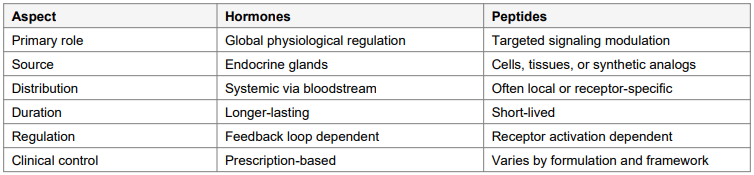
Peptides and hormones represent two foundational classes of biological signaling molecules that coordinate physiological processes throughout the human body. While both participate in essential cellular communication, they differ meaningfully in their molecular structure, signaling scope, regulatory behavior, and biological persistence.
Modern research across endocrinology, molecular biology, and regenerative science examines peptides and hormones as interacting layers of biological control. Understanding where each fit, allows for a more precise interpretation of research findings, metabolic therapies, and regulatory frameworks.
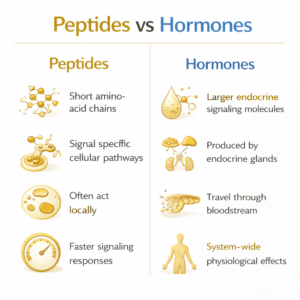
For example, certain peptides involved in growth hormone signaling are studied for their ability to influence endogenous hormone pulsatility rather than replace hormone production outright. This layered interaction underscores the complementary nature of peptide and hormone systems.
In clinical and research contexts, peptides and hormones may be studied together because they address different layers of biological signaling. Hormones establish broad systemic conditions, while peptides fine-tune specific pathways within that hormonal environment.
For example, when baseline hormone levels are insufficient to support normal physiological function, hormone replacement may restore foundational signaling. Peptides may then be studied for their ability to modulate downstream pathways, receptor sensitivity, or tissue-level responses within that restored hormonal framework.
This approach reflects a systems-based understanding of biology, where global regulation and local modulation work together rather than in opposition. Importantly, educational discussion of combined peptide and hormone use does not imply medical necessity, endorsement, or universal applicability.
Despite overlapping roles in biological communication, peptides generally do not replace hormones in a clinical sense. Hormones govern baseline physiological states, while peptides influence how those states are expressed at the cellular or tissue level.
For example, if baseline hormone levels are severely depleted, researchers observe that peptide signaling often lacks the necessary foundational environment to operate optimally. Attempting to substitute peptides for hormones ignores the distinct regulatory architecture of endocrine systems.
Understanding how the body responds to targeted peptide research requires first looking at this biological foundation. As the body ages—particularly during the menopausal transition—the natural decline of foundational hormones like estrogen and testosterone fundamentally alters systemic metabolism and cellular repair. To explore how restoring this baseline is a critical first step before introducing targeted metabolic signaling, read our deep dive into [Menopause and Hormone Health: Restoring the Biological Baseline].
One of the most severe consequences of this systemic hormonal shift is the rapid, age-related loss of skeletal muscle, a condition known as sarcopenia. Because muscle acts as the body’s primary metabolic engine and glucose sink, preserving it is the ultimate key to extending health span and metabolic efficiency. Discover why protecting this vital tissue is at the forefront of modern peptide and secretagogue research in our comprehensive guide, [Longevity and Strength: Why Muscle Matters for Aging].
Hormones are regulated as prescription therapies due to their systemic effects and potential risks. Peptides may be regulated differently depending on formulation, intended use, and jurisdiction. In Mexico, COFEPRIS oversight emphasizes documentation, sourcing, and quality controls rather than equating peptides with hormone replacement therapies.
Do peptides replace hormones?
No. Peptides and hormones serve distinct roles and are studied as complementary systems rather than replacements.
Can peptides work if hormones are low?
Research suggests baseline hormonal environment influences peptide signaling, which is why hormones and peptides are sometimes studied together.
Are peptides safer than hormones?
Safety depends on compound, context, and regulatory framework rather than category alone.
Are peptides the same as steroids?
No. Steroids are chemically distinct and operate through different mechanisms.
Why combine peptides and hormones in research?
To address both systemic regulation and targeted signaling within complex biological systems.
Endocrine system regulation and feedback loops – PubMed https://pmc.ncbi.nlm.nih.gov/articles/PMC9219553/
Peptide signaling and receptor biology – PubMed Signaling Molecules and Their Receptors – The Cell – NCBI Bookshelf
Hormone–peptide interactions in metabolic research – PubMed Discovery of peptides as key regulators of metabolic and cardiovascular crosstalk – PMC
Systems biology approaches to endocrine regulation – PubMed https://pubmed.ncbi.nlm.nih.gov/19500399/