Close
Scientific Research Context
BPC-157 (Body Protection Compound-157) is a synthetic peptide derived from a naturally occurring sequence found in human gastric juice. It has been extensively studied in preclinical and experimental research models for its role in tissue repair signaling, angiogenesis modulation, and protective cellular responses. Research interest in BPC-157 spans gastroenterology, musculoskeletal science, neurology, and regenerative biology.
Key foundational research can be reviewed via PubMed, including: Gut-cytoprotective effects of BPC-157 and BPC-157 in tissue healing models.
What Is BPC-157?
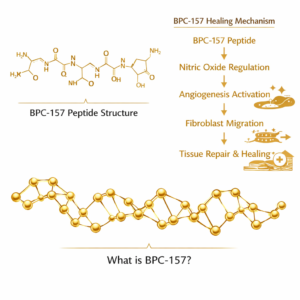
At a molecular level, BPC-157 is a highly stable signaling peptide designed to mimic the body’s innate healing mechanisms. Unlike many compounds that degrade quickly in the digestive tract, its gastric origin provides it with unique systemic stability.
BPC-157 operates through localized cellular signaling, specifically upregulating growth hormone receptors on target tissues and promoting angiogenesis. This highly targeted action perfectly illustrates the concepts detailed in our guide on [Peptides vs. Hormones: Biological Signaling]. While systemic hormones establish the broad biological environment for growth, BPC-157 acts as a precision signaling molecule, directing the body’s repair mechanisms to specific sites of inflammation, tendon damage, or gastrointestinal distress without altering baseline endocrine levels.
How BPC-157 Works
Research suggests that BPC-157 interacts with multiple signaling pathways involved in cellular protection and regeneration. Experimental studies have examined its influence on angiogenesis, nitric oxide signaling, fibroblast activity, and growth factor modulation. These mechanisms are believed to contribute to its observed effects in tissue repair and recovery models.
Collagen is the primary structural protein required for biological repair. While systemic peptides like [GHK-Cu (Copper Peptide)] are extensively researched for their ability to remodel generalized collagen networks (such as skin and systemic anti-inflammatory pathways), BPC-157 is studied for its ability to target deep, structural collagen synthesis. Research evaluating these pathways often explores how targeted angiogenesis (BPC-157) and systemic copper modulation (GHK-Cu) overlap to enhance total-body tissue integrity.
In advanced regenerative research, BPC-157 is rarely evaluated in isolation when addressing severe tissue trauma. It is most frequently studied in conjunction with [TB-500 (Thymosin Beta-4)]. While BPC-157 directs localized angiogenesis and connective tissue repair (tendons and ligaments), TB-500 operates by upregulating actin, facilitating rapid cellular migration, and supporting muscular regeneration. Together, they form a comprehensive biological research model for accelerating total-body mechanical recovery.
Furthermore, BPC-157 demonstrates a unique ability to upregulate growth hormone receptors at the site of localized injury. Because of this mechanism, researchers frequently pair it with Growth Hormone Secretagogues like [CJC-1295], [Ipamorelin], or [Tesamorelin]. In these models, the secretagogues amplify the body’s systemic release of endogenous growth hormone, while BPC-157 effectively ‘captures’ those systemic signals, hyper-focusing the cellular repair mechanisms directly onto the damaged joint, tendon, or tissue.
Beyond musculoskeletal repair, BPC-157 is heavily researched for its profound cytoprotective effects on the gastrointestinal tract. This makes it a compelling subject of study in metabolic weight-loss models.
When utilizing incretin therapies like [GLP-1 Peptides] or [Tirzepatide]—which frequently alter gut motility and induce gastrointestinal distress—researchers evaluate BPC-157 for its potential to restore the mucosal lining, soothe gastric inflammation, and support the underlying biomechanical structures as the body undergoes rapid weight reduction.
While BPC-157 demonstrates remarkable localized healing properties in laboratory settings, modern clinical research recognizes that severe tissue damage cannot be optimally repaired if the body’s foundational environment is depleted.
In advanced longevity research, maintaining skeletal muscle is recognized as the primary defense against age-related metabolic decline (explore our deep dive: [Longevity and Strength: Why Muscle Matters for Aging]). However, preserving muscle mass requires functional, pain-free mobility.
As the body ages—particularly during transitions like menopause or andropause—the natural decline of testosterone and estrogen severely blunts the body’s innate repair mechanisms. As outlined in our research on [Menopause and Hormone Health: Restoring the Biological Baseline], restoring foundational hormones (such as through clinical TRT) reignites the cellular machinery necessary for recovery. When this hormonal baseline is optimized, introducing targeted, regenerative peptide signals like BPC-157 allows researchers to observe synergistic, accelerated tissue repair that would be biologically difficult in a hormonally depleted state.
Research-Supported Areas of Study
Based on available preclinical and experimental research, BPC-157 has been studied in contexts related to:
• Tendon and ligament repair models
• Muscle and soft tissue recovery research
• Gastrointestinal mucosal protection studies
• Neuroprotective and vascular response models
• Inflammatory signaling modulation research
Clinical and Professional Research Context
In professional and clinical-adjacent research settings, BPC-157 is explored for its signaling properties and potential supportive role in tissue recovery models. Its relevance within any clinical environment depends on formulation, oversight, ethical review, and regulatory context. No therapeutic claims are implied.
Formats and Access in Mexico
BPC-157 may be encountered in oral, topical, or injectable research formats depending on the pathway and professional framework. In Mexico, BPC-157 is not classified as an over-the-counter pharmacy medication and is accessed through professional, research, or peptide-based channels.
Regulatory and Quality Oversight
Peptide handling and distribution in Mexico are subject to regulatory considerations based on intended use and formulation. Quality-focused supply chains emphasize documentation, traceability, and alignment with applicable health authority standards, including COFEPRIS requirements where relevant.
Safety and Quality Considerations
Quality considerations for BPC-157 include synthesis standards, purity testing, stability, sterility for injectable formats, and transparent documentation. Improper handling or unverified sources may introduce safety risks.
Frequently Asked Questions
Is BPC-157 available in pharmacies in Mexico?
It is not typically sold as an over-the-counter pharmacy medication.
Does BPC-157 have human clinical trials?
Most published research is preclinical or experimental in nature.
Selected Scientific References
Sikiric P et al. Stable gastric pentadecapeptide BPC-157 https://pubmed.ncbi.nlm.nih.gov/31158953/
Sikiric P et al. BPC-157 and tissue healing mechanisms. PubMed http://Sikiric P et al. BPC-157 and tissue healing mechanisms. PubMed
Sever M et al. BPC-157 in tendon and ligament healing models. PubMed https://pubmed.ncbi.nlm.nih.gov/25415472/
Vukojevic J et al. BPC-157 and neuroprotective signaling. PubMed
Staresinic M et al. Angiogenic effects of BPC-157. PubMed https://pubmed.ncbi.nlm.nih.gov/29879879/