
Close
Scientific Review: Verified by the Myosfit Laboratory Team | Updated: March 2026
If you’ve spent any time in wellness circles, skincare aisles, or fitness forums lately, you’ve likely heard the word «peptides» whispered as if it’s a modern-day fountain of youth. From «peptides for weight loss» to «peptides for the skin,» the buzz is undeniable. But for many, these tiny molecules remain a mystery.
Why is there so much excitement? According to research published in Drug Discovery Today, the surge is due to peptides’ unique ability to act as high-affinity, low-toxicity signaling molecules (Fosgerau & Hoffmann, 2015). To understand why they are a central area of interest in regenerative science, we have to look past the marketing and into the molecular biology.
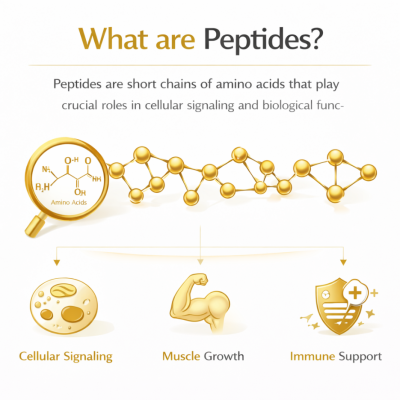
To understand what peptides are, think of them as the «middle ground» of the biological world. Peptides are short chains of amino acids—the fundamental building blocks of life. When these amino acids link together, they form a peptide. If that chain exceeds 50 amino acids, it becomes a protein.
The LEGO Analogy:
Amino Acids: Individual building blocks (single bricks).
Peptides: Short, targeted strings (2 to 50 bricks).
Proteins: Long, complex structures (50+ bricks, like collagen or muscle fiber).
Because peptides are smaller than proteins, they are more agile and can penetrate cell membranes effectively (Zhang & Bulaj, 2012). At Myosfit, we synthesize specific sequences to trigger particular biological responses. If you are looking to source these materials, it is vital to understand the Safety & Legality of Peptides in Mexico.
Peptides are the «text messages» of the body. They travel to specific receptors on cell surfaces, «plug in,» and deliver a command. This is known as the «lock and key» mechanism (Walewska et al., 2019).
Examples of Peptide Commands
Skin Integrity: «Start producing more collagen right now.» → Shop GHK-Cu Copper Peptide]
Metabolic Reset: «Slow down digestion and silence food noise.» → Shop Retatrutide (Triple-Agonist)]
Tissue Repair: «Accelerate the healing of muscles and tendons.» → Shop BPC-157 (Body Protection Compound)]
Why Are People Talking About Them? (The Peptide Boom)
The sudden surge in popularity isn’t accidental. It’s driven by a shift toward bio-optimization and regenerative medicine. People are no longer just looking for «anti-aging» creams; they are looking for ways to signal their bodies to function at a younger, more efficient level.
People are talking about them because peptides offer a more «clinical-adjacent» way to manage health. They aren’t foreign chemicals; they are synthetic versions of the very signals your body already produces. As we age, our natural production of these signaling peptides drops. By supplementing them, we are essentially «restoring the signal» to a system that has grown quiet over time.
Furthermore, the rise of «precision medicine» has moved away from «one-size-fits-all» drugs toward molecules that can be tailored to a person’s specific physiological needs—whether that is recovering from a torn injury or managing a metabolic disorder.
A common question is whether these messengers are just hormones. While all peptide hormones (like insulin) are peptides, not all peptides are hormones.
Hormones are «broadcast signals» that affect entire organ systems. In contrast, many peptides are paracrine messengers, acting locally on neighboring cells. This «surgical» precision is a key reason why researchers are comparing Peptides vs. Bioidentical Hormones to determine which is best for targeted recovery.
To understand the practical application of this science, we look at the specific peptides currently dominating the research landscape. You will find detailed breakdowns of these in our education portal:
Retatrutide: The Triple Agonist Retatrutide represents the cutting edge of metabolic research. While older generations of weight-loss peptides targeted one or two receptors, Retatrutide targets three: GLP-1, GIP, and Glucagon. This triple-action approach helps regulate appetite, improve how the body burns fat, and manages blood sugar levels more effectively than previous iterations.
CJC-1295: (The Growth Signal): A GHRH analog that signals the pituitary gland to release natural growth hormone pulses, essential for maintaining Muscle: The Organ of Longevity. → Shop CJC-1295 + Ipamorelin
TB-500 (Cellular Migration): Derived from Thymosin Beta-4, it helps the «construction crew» of cells move to the site of an injury. → Shop TB-500
Because peptides are made of amino acids, the delivery method is crucial. If swallowed, stomach acid can break certain peptides down before they send their signal.
Topical: Best for skincare (GHK-Cu).
Injectable: The most common research method for systemic issues, ensuring the peptide enters the bloodstream intact.
Oral/Nasal: Breakthroughs now allow certain peptides (like BPC-157) to be stable enough for oral or nasal research.
Peptides are becoming integral in managing age-related transitions. For those navigating the complexities of Menopause and Hormonal Health, peptides offer a way to optimize metabolic health and skin elasticity without the broad systemic impact of traditional HRT.
By «restoring the signal» to a system that has grown quiet over time, peptides allow for a more personalized approach to longevity (Craik et al., 2013).
Summary: The Future of Precision Health
Peptides represent a shift from «treating symptoms» to «optimizing signals.» Whether you are interested in peptides for the skin, weight loss, or injury recovery, the core principle remains the same: using the body’s own language of amino acids to trigger specific, beneficial results.
As we continue to map the human proteome, the potential for peptides only grows. They offer a future where we don’t just «wait to get old» or «wait to get hurt,» but rather use precise molecular signals to maintain the body at its highest possible level of function.
Regulatory Considerations in Mexico
In Mexico, peptides are subject to regulatory oversight by COFEPRIS. Professional-grade peptides must be handled within structured supply chains that emphasize purity testing and molecular verification. For more information on navigating the landscape, read our 2026 Mexico Peptide Guide.
Frequently Asked Questions
What is the difference between peptides and proteins?
Peptides are shorter chains of amino acids, while proteins are larger and more complex structures.
Are peptides pharmaceutical drugs?
Some peptides are developed as drugs, while others are studied in professional or research-based contexts depending on regulation.
How is peptide quality evaluated?
Quality is assessed through purity testing, molecular verification, documentation, and handling standards.
Selected Scientific References
Fosgerau K, Hoffmann T. Peptide therapeutics: current status and future directions. Drug Discovery Today, 2015. PubMed https://pubmed.ncbi.nlm.nih.gov/25450771/
Lau JL, Dunn MK. Therapeutic peptides: historical perspectives and future directions. Bioorganic & Medicinal Chemistry, 2018. PubMedhttps://pubmed.ncbi.nlm.nih.gov/28237515/
Craik DJ et al. The future of peptide-based drugs. Chemical Biology & Drug Design, 2013. PubMed https://pubmed.ncbi.nlm.nih.gov/23253135/
Zhang L, Bulaj G. Converting peptides into drug leads through stabilization strategies. Curr Opin Chem Biol, 2012. PubMed https://pubmed.ncbi.nlm.nih.gov/22376031/
Walewska A et al. Peptide signaling mechanisms in human physiology. Front Endocrinol, 2019. PubMed https://pubmed.ncbi.nlm.nih.gov/30340332/

Professionally sourced peptides with an emphasis on quality, documentation, and responsible handling.


• What peptides really are and how they function inside the body
• The logic and structure behind high-performance MyosFit stacks
• Fat loss, muscle recovery, sleep, longevity, and skin optimization strategies
• How advanced stacks are engineered, not guessed
• What defines clinical-grade peptides,s and why most products fail that standard
The date has not been announced yet – join the early interest list to be notified first when registration opens.
Signup for news and special offers!
You have successfully joined our subscriber list.