Close
GHK-Cu peptide (Copper Tripeptide-1) is one of the most searched regenerative compounds in Mexico, particularly for its role in skin repair, anti-aging, and tissue regeneration. Interest has grown around its benefits, pricing, injectable formats, and where it can be accessed within professional and cosmetic frameworks.
Unlike hormones, peptides like GHK-Cu function as targeted signaling molecules that support processes such as collagen production, healing, and inflammation control. If you’re new to peptides, start with your peptide education hub and foundational guides like what peptides are and peptides vs hormones before exploring compound-specific applications.
Most individuals exploring GHK-Cu compare it with other regenerative peptides based on their primary goal:
Skin and collagen regeneration
Localized injury repair
Full-body recovery
Explore related options:
👉 BPC-157 for injury and connective tissue repair
👉 TB-500 for systemic recovery and full-body repair
GHK-Cu is extensively studied for its regenerative properties, particularly in dermatologic and tissue repair contexts.
GHK-Cu supports collagen and elastin production—two structural proteins essential for maintaining skin firmness and elasticity. As natural levels decline with age, this signaling pathway becomes increasingly important for maintaining dermal integrity.
Research shows GHK-Cu plays a role in wound healing and tissue remodeling by promoting the replacement of damaged structures with functional tissue.
PubMed: https://pubmed.ncbi.nlm.nih.gov/29986520/
GHK-Cu has also been explored for its ability to improve the environment surrounding hair follicles, supporting scalp health and potentially influencing hair density conditions.
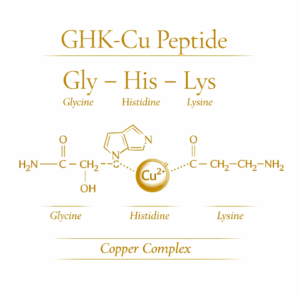
GHK-Cu operates as a multi-target signaling peptide, influencing several biological systems simultaneously.
Studies suggest GHK-Cu affects genes involved in repair, inflammation, and regeneration.
https://pubmed.ncbi.nlm.nih.gov/26236730/
It stimulates fibroblasts to produce collagen while also breaking down damaged extracellular matrix (ECM) components, enabling tissue renewal.
GHK-Cu helps regulate oxidative stress and inflammatory responses, which are key contributors to aging and tissue degradation.
PubMed: https://pubmed.ncbi.nlm.nih.gov/35083444/
Research suggests that natural levels of GHK-Cu decline with age, which may contribute to reduced regenerative capacity and slower tissue repair over time
https://pubmed.ncbi.nlm.nih.gov/24138703/
GHK-Cu is most often explored by individuals focused on:
Skin regeneration and anti-aging support
Post-injury tissue repair and recovery
Hair and scalp health optimization
Ready to apply these mechanisms to real-world skin or recovery protocols?
GHK-Cu is rarely studied in isolation when full-spectrum tissue repair is the goal. Instead, it is often evaluated alongside other peptides that target deeper or complementary biological pathways.
For example, when focusing on connective tissue and internal repair, GHK-Cu is frequently paired with BPC-157, which is studied for its role in angiogenesis and healing of tendons and soft tissue.
In recovery and performance-focused models, GHK-Cu may also be combined with TB-500, a peptide explored for its ability to support cellular migration and systemic repair signaling.
For broader aesthetic and skin-focused protocols, GHK-Cu is sometimes included within multi-compound approaches such as a Glow Stack, where multiple peptides are evaluated together for surface-level regeneration and appearance optimization.
👉 This layered approach reflects how regenerative peptides are used in advanced frameworks—each compound targeting a different phase of the repair process rather than relying on a single pathway.
This approach also connects to broader performance and recovery strategies such as Muscle Longevity, where tissue resilience and repair are key factors.
If your focus is skin, collagen, and surface-level regeneration, GHK-Cu remains the most targeted option.
Explore peptide options based on your recovery and regeneration goals:
View Recovery Peptide Options →
Search behavior shows strong interest in injectable formats, so clarity here is essential.
Injectable GHK-Cu
In Mexico, these formats exist in different access pathways, and they should not be treated as interchangeable.
GHK-Cu is not typically available as a standard over-the-counter pharmaceutical product in Mexico. Instead, it is accessed through cosmetic providers, peptide suppliers, and professional-use channels.
Search trends show strong demand for injectable formats and professional-grade sourcing, but availability depends on supplier transparency, regulatory alignment, and intended use.Rather than focusing only on price, evaluating documentation, sourcing standards, and compliance frameworks is critical when considering GHK-Cu in any format.
To explore verified and professionally sourced GHK-Cu peptide options:
View GHK-Cu Peptide Options in Mexico
Pricing is one of the most searched aspects—and one of the most misunderstood.
GHK-Cu pricing in Mexico depends on:
Typical pricing varies widely depending on format and quality. Cosmetic formulations tend to fall within lower price ranges, while injectable or research-grade formats command higher pricing due to manufacturing complexity and handling requirements.
Significant price differences often reflect purity, testing standards, and supplier credibility rather than just brand positioning
Usage depends heavily on the form and context.
There is no standardized universal protocol for GHK-Cu use. Application depends on whether it is used in topical cosmetic routines or explored in professional and research-based settings.
Misapplying dosage assumptions across formats is a common mistake—topical and injectable contexts operate under entirely different frameworks.
Used in skincare routines to target dermal layers.
In some cases, GHK-Cu is explored within structured protocols under supervision.
The key takeaway:
There is no universal protocol—context determines application.
GHK-Cu is one of the most researched regenerative peptides, with demonstrated roles in:
However, its effectiveness depends on: