
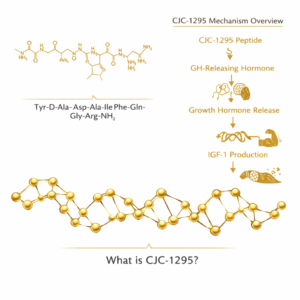
CJC-1295 is a synthetic growth hormone–releasing hormone (GHRH) analog studied for its ability to stimulate natural growth hormone production through pituitary signaling pathways. Unlike direct hormone replacement therapies, CJC-1295 supports endogenous hormone release, preserving the body’s natural pulsatile rhythm.
To understand the biological foundation of these compounds, explore What Are Peptides, where peptide signaling and molecular function are explained in detail. For a deeper comparison between signaling molecules and hormones, see Peptides vs Hormones.
Within broader optimization frameworks, CJC-1295 is commonly discussed as part of Performance Peptides, where muscle growth, recovery, and metabolic strategies are explored.
CJC-1295 functions by binding to GHRH receptors in the anterior pituitary gland, triggering the release of endogenous growth hormone. Unlike exogenous HGH, this process maintains physiological signaling patterns rather than overriding them.
Research demonstrates that long-acting GHRH analogs can significantly increase GH and IGF-1 levels through receptor-mediated signaling (https://pubmed.ncbi.nlm.nih.gov/15713731/).
CJC-1295 is modified to resist enzymatic degradation, allowing for prolonged biological activity. This extended half-life enables sustained GH release compared to native GHRH peptides.
Studies on long-acting GHRH analogs highlight prolonged endocrine signaling and stability improvements (https://pubmed.ncbi.nlm.nih.gov/16449353/).
One of the most important aspects of CJC-1295 is its ability to maintain the body’s natural growth hormone rhythm. Instead of continuous hormone exposure, it supports regulated endocrine signaling patterns.
Research on GH secretion dynamics confirms the importance of pulsatile hormone release for physiological balance (https://pubmed.ncbi.nlm.nih.gov/9153447/).
Search trends show that users are primarily looking for:
CJC-1295 is studied for:
Growth hormone signaling plays a direct role in protein synthesis and lipid metabolism, supporting improved body composition (https://pubmed.ncbi.nlm.nih.gov/11739357/).
One of the most searched combinations is CJC-1295 + Ipamorelin.
Ipamorelin works as a growth hormone secretagogue (GHRP), providing a strong pulse of GH release, while CJC-1295 extends the duration of that signal.
This creates the well-known “pulse and sustain” effect, a central concept in Performance Peptides strategies.
For more detail, see Ipamorelin in Mexico.
A major search query is:
👉 “how much CJC-1295 per day”
In research settings:
These approaches aim to optimize GH signaling while maintaining physiological balance rather than overstimulation.
Another high-intent search is:
👉 “Is CJC-1295 the same as HGH?”
The answer is no.
Research suggests endogenous stimulation may offer more regulated hormonal responses compared to exogenous hormone delivery (https://pubmed.ncbi.nlm.nih.gov/10403571/).
Within the context of peptides in Mexico, CJC-1295 is commonly explored in structured protocols targeting:
To explore the full category, visit the Performance Peptides section.
You can also return to the Peptide Education Hub to understand how CJC-1295 fits into broader peptide systems.
CJC-1295 → sustained GH signaling
Ipamorelin → pulsatile GH release
Tesamorelin → metabolic support
According to compiled research and endocrine models , CJC-1295 has been studied in:
👉 “does CJC-1295 work quickly?”
CJC-1295 works through endocrine signaling, meaning effects are studied over time rather than immediate stimulation. Research evaluates changes in GH and IGF-1 levels over days to weeks depending on protocol design.
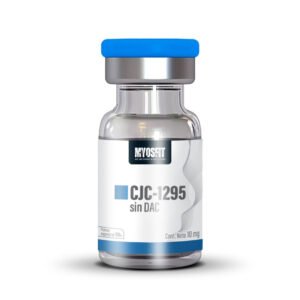
Explore CJC-1295 Options Professionally sourced CJC-1295 formulations with an emphasis on quality, documentation, and COFEPRIS-registered laboratory sourcing.
CJC-1295 is studied for its ability to stimulate natural growth hormone production by activating receptors in the pituitary gland. This leads to increased GH and IGF-1 signaling, which are associated with muscle recovery, tissue repair, metabolic function, and overall hormonal balance over time.
Research indicates that CJC-1295 can increase circulating growth hormone and IGF-1 levels through receptor-mediated signaling pathways. Its effectiveness is evaluated in controlled settings, where results depend on dosing protocols, biological response, and whether it is used alone or alongside complementary peptides.
Dosage varies depending on the research model and whether CJC-1295 is used with or without DAC. Protocols are designed to support natural hormonal rhythms, and studies typically evaluate dosing strategies based on frequency, duration, and individual physiological response rather than a fixed universal amount.
The legal status of CJC-1295 in Mexico depends on its classification, formulation, and intended use. It is generally not sold as a standard over-the-counter pharmaceutical and is typically accessed within regulated research or specialized peptide distribution frameworks.
No, CJC-1295 is not the same as HGH. CJC-1295 stimulates the body’s natural production of growth hormone through signaling pathways, while HGH (somatropin) introduces the hormone directly into the body. This difference affects how each compound interacts with endocrine regulation and physiological balance.
• What peptides really are and how they function inside the body
• The logic and structure behind high-performance MyosFit stacks
• Fat loss, muscle recovery, sleep, longevity, and skin optimization strategies
• How advanced stacks are engineered, not guessed
• What defines clinical-grade peptides,s and why most products fail that standard
The date has not been announced yet – join the early interest list to be notified first when registration opens.
Signup for news and special offers!
You have successfully joined our subscriber list.