
Close
Peak physical performance and long-term muscle development are driven by precise biological signaling. Performance peptides in Mexico are studied for their ability to enhance growth hormone release, accelerate recovery, and improve metabolic efficiency through targeted physiological pathways.
Unlike synthetic hormone replacement, these compounds are explored for stimulating the body’s natural systems—particularly the pituitary and mitochondrial networks—allowing for more controlled and adaptive performance optimization.
To understand how these signaling systems work at a foundational level, visit the Peptide Education Hub, where peptide categories and mechanisms are explained in detail.
Performance peptides are compounds studied for their ability to influence biological systems related to muscle growth, recovery, and energy production. These include:
Unlike direct hormone administration, peptides act as signaling molecules that stimulate endogenous (natural) production. For a deeper comparison of these mechanisms, see Peptides vs Hormones.
To understand peptide fundamentals, explore What Are Peptides.
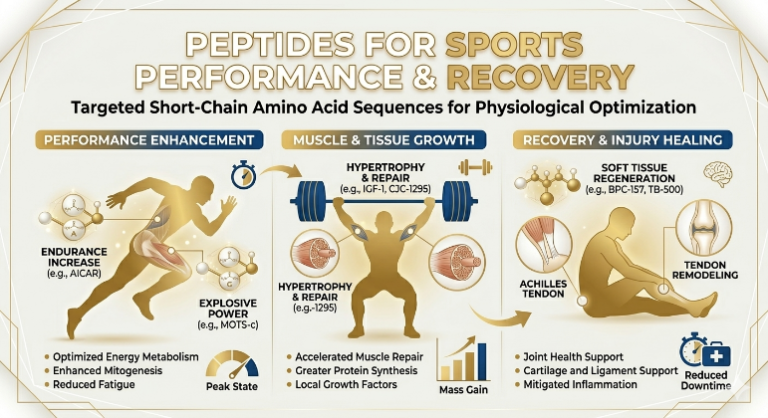
One of the most studied approaches in performance optimization is the “pulse and sustain” methodology, which mimics the body’s natural growth hormone rhythm.
This approach combines:
Together, they create a synergistic effect on pituitary signaling and hormone release (https://pubmed.ncbi.nlm.nih.gov/9153447/).
The combination of CJC-1295 and Ipamorelin is studied as a dual-action system:
This pairing mimics natural endocrine rhythms while supporting lean muscle mass and recovery.
For more detailed research, see CJC-1295 in Mexico. Research on growth hormone–releasing peptides further supports their role in stimulating pituitary function and improving recovery pathways (https://pubmed.ncbi.nlm.nih.gov/10403571/).
For those targeting advanced hypertrophy, IGF-1 LR3 is studied for its ability to go beyond standard muscle growth.
Unlike hypertrophy (increasing muscle size), IGF-1 LR3 supports hyperplasia, or the formation of new muscle fibers through satellite cell activation (https://pubmed.ncbi.nlm.nih.gov/11739357/).
This process plays a key role in:
Performance is not just about muscle—it’s about energy systems.
Mitochondrial peptides such as MOTS-c are studied for improving metabolic flexibility and cellular energy production. Research suggests MOTS-c plays a role in regulating insulin sensitivity and metabolic stress adaptation (https://pubmed.ncbi.nlm.nih.gov/25738861/).
Additional studies highlight its importance in maintaining metabolic efficiency and endurance capacity (https://pubmed.ncbi.nlm.nih.gov/30635483/).
These mechanisms are essential for athletes pushing high-intensity workloads and recovery cycles.
Peptides like CJC-1295 and Ipamorelin stimulate natural GH release, supporting lean muscle growth and recovery without suppressing endogenous production.
IGF-1 LR3 is studied for increasing the number of muscle cells rather than just enlarging existing ones, making it a key compound in advanced physique development.
MOTS-c supports mitochondrial efficiency, allowing for sustained energy output and faster recovery from metabolic stress.
Within the growing field of performance peptides in Mexico, these compounds are commonly explored for:
They are often used within structured protocols that combine multiple peptides targeting different biological systems.
For a broader perspective on long-term physical optimization, explore Muscle Longevity.
In Mexico, peptides are distributed within regulatory frameworks that emphasize traceability, documentation, and quality sourcing. Availability depends on classification, formulation, and intended research use.
For a full breakdown of peptide categories and usage frameworks, return to the Peptide Education Hub.
Combining a GHRH (CJC) with a GHRP (Ipamorelin) creates a synergistic effect that maximizes the natural Growth Hormone release from the pituitary gland while maintaining a natural, healthy pulse.
They are studied for enhancing muscle growth, recovery, and metabolic efficiency through targeted biological signaling.
Peptides stimulate natural production, while HGH delivers direct hormone levels. The approach depends on research goals and protocols.
Performance peptides are studied within controlled research frameworks, with long-term effects evaluated based on biological response, dosage protocols, and overall physiological context.
These compounds act through adaptive biological systems, meaning results are studied over time rather than immediate stimulation.


• What peptides really are and how they function inside the body
• The logic and structure behind high-performance MyosFit stacks
• Fat loss, muscle recovery, sleep, longevity, and skin optimization strategies
• How advanced stacks are engineered, not guessed
• What defines clinical-grade peptides,s and why most products fail that standard
The date has not been announced yet – join the early interest list to be notified first when registration opens.
Signup for news and special offers!
You have successfully joined our subscriber list.