
Close
Last updated: April 2026 • Reviewed by Myosfit for accuracy and relevance in immune peptide research.
Explore immune and inflammation peptides designed to support recovery, gut health, and cellular defense.
Immune system peptides in Mexico are increasingly explored within modern strategies focused on inflammation control, gut health, and cellular defense. As interest in peptides in Mexico continues to grow, understanding how these compounds function—and how to evaluate quality and sourcing—has become essential for anyone exploring this category.
Unlike generalized approaches, immune-related peptides are studied for their ability to act as targeted biological signals, influencing inflammatory pathways, immune response, and tissue repair. For a complete overview of how peptide signaling works, start with the Peptides in Mexico Education Hub, or review foundational guides like What Are Peptides in Mexico and Peptide Sourcing in Mexico to better understand how quality and application differ across providers.
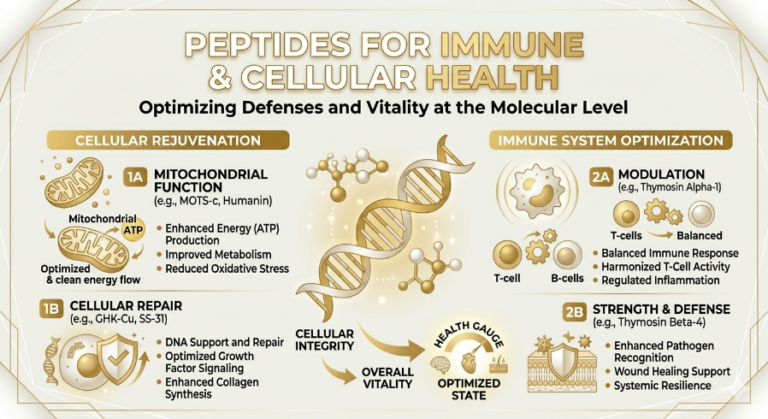
Immune peptides function as cellular signaling regulators, helping coordinate communication between immune cells, tissues, and inflammatory pathways. Rather than broadly stimulating or suppressing the immune system, these compounds are studied for their ability to modulate specific responses, which is why they are often explored in more structured approaches.
Research has examined how peptide signaling influences inflammatory balance and immune coordination across multiple biological systems (https://pubmed.ncbi.nlm.nih.gov/). This level of specificity is what separates immune peptides from broader approaches and explains why they are frequently explored alongside regenerative peptides and cognitive peptides within more advanced frameworks.
KPV is widely studied for its role in regulating inflammation, particularly within the gastrointestinal system. Research on KPV in Mexico highlights its association with cytokine modulation and gut-related inflammatory pathways (https://pubmed.ncbi.nlm.nih.gov/). Because of this, KPV is frequently explored in structured approaches focused on digestive health and inflammation balance.
LL-37 is an antimicrobial peptide involved in innate immune defense. Studies on LL-37 in Mexico examine its role in protecting against pathogens while also influencing inflammatory response and tissue repair (https://pubmed.ncbi.nlm.nih.gov/). Within the context of peptides in Mexico, LL-37 is commonly explored for its dual role in immune signaling and cellular defense.
Thymosin Alpha 1 is researched for its role in supporting immune system signaling, particularly T-cell activation and adaptive immunity. Within immune-focused strategies, Thymosin Alpha 1 is often evaluated as part of broader approaches that aim to support immune balance and regulation.
VIP plays a dual role in immune and neurological signaling. It is studied for its influence on inflammation and its interaction with neuroimmune pathways, making VIP relevant in systemic strategies that extend beyond isolated immune responses (https://pubmed.ncbi.nlm.nih.gov/).
Although commonly associated with regenerative applications, GHK-Cu is also studied for its role in inflammation control and cellular signaling related to tissue repair. Its interaction with repair pathways makes it a complementary component within broader immune-focused strategies.
Within modern frameworks, immune system peptides in Mexico are explored for their potential role in regulating inflammatory processes, supporting gut health, and maintaining immune system balance. These compounds are rarely viewed in isolation and are instead considered part of broader, structured strategies.
Common areas of exploration include chronic inflammation, immune signaling, tissue recovery, and the interaction between immune and nervous system pathways. Ongoing research continues to evaluate how peptide-based signaling influences systemic balance and recovery across different biological environments (https://pubmed.ncbi.nlm.nih.gov/).
Because of this, immune peptides are often integrated with categories such as regenerative peptides and cognitive peptides depending on the specific goal and pathway being targeted.
When evaluating peptides in Mexico, quality remains one of the most critical factors. Differences in purity, handling, and storage can significantly impact consistency and outcomes.
Reliable sourcing involves third-party testing, batch consistency, and controlled storage practices. Understanding these variables is essential when comparing available options, which is why reviewing Peptide Sourcing in Mexico is an important step when evaluating providers.
Immune peptides are rarely explored in isolation. Instead, they are typically part of layered approaches that include metabolic, regenerative, and neuroimmune pathways.
For example, inflammation-focused strategies often overlap with tissue repair, while neuroimmune interactions connect immune signaling with cognitive function. Returning to the Peptides in Mexico Education Hub provides a clearer view of how these categories connect and how different peptide types are organized based on real-world goals.
Immune system peptides are signaling molecules studied for their role in regulating inflammation, cellular defense, and immune communication. Within the context of peptides in Mexico, they are typically explored as part of structured approaches focused on inflammation balance and recovery.
They interact with cellular receptors to influence immune signaling and inflammatory pathways. Compounds such as KPV and LL-37 are studied for inflammation modulation, while others influence adaptive immune function.
Commonly researched compounds include KPV, LL-37, Thymosin Alpha 1, and VIP, each studied for different roles in immune signaling and cellular defense.
Differences in purity and handling directly affect consistency, which is why verification and proper sourcing practices are essential.


• What peptides really are and how they function inside the body
• The logic and structure behind high-performance MyosFit stacks
• Fat loss, muscle recovery, sleep, longevity, and skin optimization strategies
• How advanced stacks are engineered, not guessed
• What defines clinical-grade peptides,s and why most products fail that standard
The date has not been announced yet – join the early interest list to be notified first when registration opens.
Signup for news and special offers!
You have successfully joined our subscriber list.