
Close
Ready to explore regenerative peptide options based on your recovery goals?
Regenerative peptides in Mexico are increasingly explored for their role in tissue repair, recovery optimization, and cellular regeneration. These bioactive compounds function as signaling molecules that help coordinate the body’s natural healing processes rather than forcing artificial responses.
If you’re new to peptide-based therapies, start with the Peptide Education Hub, then explore how regenerative peptides in Mexico are applied in structured recovery and performance frameworks.
Most individuals exploring regenerative peptides in Mexico compare options based on their primary goal:
Localized injury repair
Full-body recovery
Collagen and tissue regeneration
Compare your options:
👉 BPC-157 for localized injury recovery
👉 TB-500 for full-body repair support
👉 GHK-Cu for collagen, skin, and tissue regeneration
Regenerative peptides are short chains of amino acids that signal biological repair pathways, supporting healing at the cellular level. Unlike traditional treatments, they work by enhancing the body’s natural recovery processes, including blood flow, inflammation control, and tissue remodeling.
Research into peptide signaling shows their role in tissue repair and regeneration pathways, particularly through angiogenesis and cellular migration
PubMed: https://pubmed.ncbi.nlm.nih.gov/22074294/
Regenerative peptides primarily function by activating key biological mechanisms involved in healing.
They support:
Studies demonstrate how these peptides influence gene expression and healing pathways at a cellular level
PubMed: https://pubmed.ncbi.nlm.nih.gov/26236730/
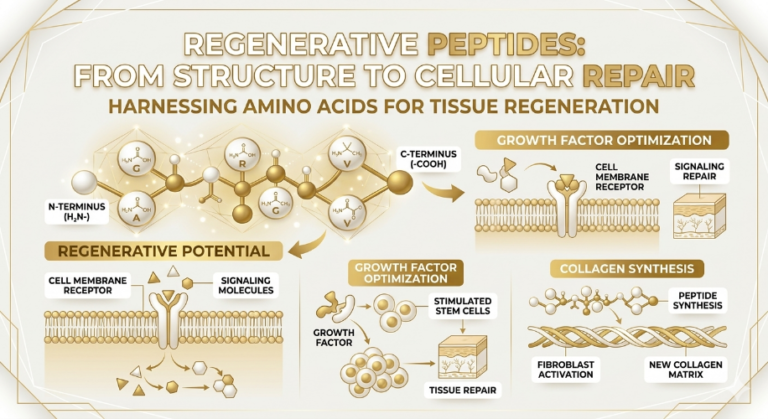
Peptides such as BPC-157 and TB-500 are studied for their role in repairing muscle, tendon, and ligament damage by accelerating recovery processes.
These compounds help shift the body from a pro-inflammatory state to a healing state, improving recovery efficiency and reducing chronic inflammation. Research supports their involvement in anti-inflammatory pathways
PubMed: https://pubmed.ncbi.nlm.nih.gov/35083444/
Peptides like GHK-Cu play a critical role in collagen synthesis and extracellular matrix remodeling
PubMed: https://pubmed.ncbi.nlm.nih.gov/17513484/
The most commonly studied regenerative peptides in Mexico include BPC-157 in Mexico, TB-500 in Mexico, and GHK-Cu in Mexico, each playing a distinct role in tissue repair and recovery.
For targeted healing and localized tissue repair, BPC-157 in Mexico is often explored due to its association with angiogenesis and connective tissue recovery, particularly in tendons, ligaments, and gastrointestinal tissues.
For broader systemic recovery, TB-500 in Mexico is studied for its ability to support cellular migration and coordinate repair processes throughout the body, making it relevant in full-body recovery frameworks.
For collagen production and structural regeneration, GHK-Cu in Mexico is widely recognized for its role in skin repair, extracellular matrix remodeling, and overall tissue regeneration.
Together, these peptides form the foundation of most regenerative strategies, where each compound targets a different phase of the healing process rather than relying on a single mechanism.
When evaluating regenerative peptides in Mexico, the most important factors are formulation quality, sourcing transparency, and intended use.
Rather than focusing on individual compounds alone, structured approaches prioritize how peptides are selected based on recovery goals—whether targeting localized tissue repair, systemic recovery, or collagen and skin regeneration.
High-quality peptide formulations emphasize purity, testing standards, and documented sourcing, which ultimately determines consistency and reliability in research or professional-use frameworks.
Once foundational understanding is established, regenerative peptides are often evaluated based on how they are applied within recovery or performance frameworks.
Instead of focusing on isolated compounds, product selection typically aligns with specific goals such as localized repair, systemic recovery, or collagen and tissue regeneration.
For localized injury and inflammation, BPC-157 formulations → for localized injury and tendon repair are commonly explored due to their association with angiogenesis and connective tissue healing, particularly in tendons and ligaments.
For broader recovery and whole-body repair processes, TB-500 peptide formulations→ for systemic recovery and full-body repair are often evaluated for their role in cellular migration and coordinated tissue healing across multiple systems.
In applications focused on collagen production and structural repair, GHK-Cu peptide formulations→ for collagen, skin, and tissue remodeling are frequently used to support extracellular matrix remodeling and skin regeneration.
In more advanced frameworks, these peptides are combined into structured approaches such as the Wolverine Stack, where multiple biological pathways are targeted simultaneously to support faster and more complete recovery.
Ready to explore available recovery peptides?
Regenerative peptides in Mexico exist within research and professional-use frameworks rather than standard pharmaceutical classifications. Availability depends on intended use, regulatory context, and supplier compliance.
Regenerative peptides represent a shift toward signaling-based recovery rather than direct intervention. By supporting natural healing pathways such as angiogenesis, collagen production, and inflammation control, they offer a structured approach to tissue repair and performance optimization.
Their effectiveness depends on:
Regenerative peptides are studied for their role in tissue repair, recovery support, inflammation modulation, and cellular regeneration. In Mexico, they are commonly explored in professional-use and research frameworks involving muscle, tendon, ligament, skin, and soft tissue recovery.
The most common regenerative peptides in Mexico include BPC-157, TB-500, and GHK-Cu. BPC-157 is often associated with localized repair, TB-500 with systemic cellular migration, and GHK-Cu with collagen production and tissue remodeling.
Regenerative peptides work by signaling repair pathways involved in angiogenesis, cellular migration, collagen synthesis, and inflammation control. Instead of forcing a direct effect, they help coordinate the body’s natural healing response.
Yes. Regenerative peptides are often studied in combination because different compounds support different repair mechanisms. For example, BPC-157 may support localized healing, TB-500 may support broader cellular migration, and GHK-Cu may support collagen and skin regeneration.
Regenerative peptides in Mexico are generally accessed through research, professional-use, or clinical-adjacent frameworks rather than standard over-the-counter pharmacy channels. Availability depends on formulation, intended use, sourcing standards, and regulatory context.
Ready to explore regenerative peptides based on your recovery goals?
View Recovery Peptide Options in Mexico


• What peptides really are and how they function inside the body
• The logic and structure behind high-performance MyosFit stacks
• Fat loss, muscle recovery, sleep, longevity, and skin optimization strategies
• How advanced stacks are engineered, not guessed
• What defines clinical-grade peptides,s and why most products fail that standard
The date has not been announced yet – join the early interest list to be notified first when registration opens.
Signup for news and special offers!
You have successfully joined our subscriber list.