Angiogenesis and Blood Flow Support
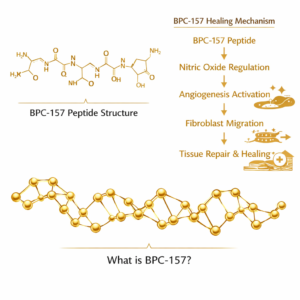
Angiogenesis is the formation of new blood vessels, which is essential for delivering oxygen, nutrients, and growth signals to damaged tissue. BPC-157 is studied for its ability to support vascular response, especially in tissues with limited blood flow.
This mechanism is important for tendon, ligament, and soft tissue recovery because these structures often heal slowly due to poor vascularization.
Collagen Remodeling and Structural Repair
Collagen is the primary structural protein involved in tendon, ligament, skin, and connective tissue repair. BPC-157 is researched for its ability to influence collagen organization and remodeling in damaged tissue.
Studies examining tendon and ligament models suggest BPC-157 may support recovery through improved structural repair signaling (https://pubmed.ncbi.nlm.nih.gov/25415472/).
BPC-157 is often discussed alongside GHK-Cu, which is studied for broader collagen remodeling and skin repair. While GHK-Cu is more systemic in collagen-related research, BPC-157 is more often associated with localized structural recovery.
Nitric Oxide Signaling and Inflammation Modulation
BPC-157 is also studied for its interaction with nitric oxide pathways, which play a role in circulation, inflammation control, and tissue response. This makes it relevant in research models involving inflammation, musculoskeletal stress, and vascular repair.
Because these pathways overlap with recovery and performance, BPC-157 is commonly discussed within both regenerative and muscle longevity frameworks. For a broader view of how tissue repair supports long-term physical function, see Muscle Longevity.
BPC-157 and TB-500: Regenerative Peptide Stack
One of the most searched combinations is BPC-157 and TB-500. These peptides are often studied together because they target different but complementary repair pathways.
BPC-157 is commonly associated with localized tissue repair, angiogenesis, tendon signaling, and gastrointestinal protection. TB-500 is studied for actin regulation, cellular migration, muscular repair, and broader tissue remodeling.
Together, they form a regenerative research model often called the Wolverine Stack, which is explored for total-body recovery and mechanical repair. For deeper related education, see TB-500 in Mexico.
Product links should flow naturally here: BPC-157 is often studied alongside TB-500 for tissue repair, GHK-Cu for collagen and skin remodeling, and the Wolverine Stack for broader regenerative recovery protocols.
If your focus is localized injury repair, BPC-157 is typically the primary peptide explored before adding systemic compounds like TB-500.
Explore related peptide education:
👉 TB-500 peptide guide
View Recovery Peptide Options
BPC-157 and Gut Health Research
Beyond musculoskeletal recovery, BPC-157 is heavily researched for gastrointestinal protection. Because it is derived from a gastric peptide sequence and remains stable in acidic environments, it is studied in models involving mucosal protection, gut barrier function, inflammation, and intestinal repair.
This makes BPC-157 relevant for researchers studying the gut-brain axis, metabolic stress, and recovery protocols where gastrointestinal integrity plays a major role in systemic health.
In practical peptide education, BPC-157 is often positioned as both a regenerative peptide and gut-support peptide such as KPV, depending on the research model.
BPC-157 Injections, Oral Formats and Research Access in Mexico
A major search pattern around this page includes BPC-157 Mexico pharmacy, BPC-157 injectable Mexico, and BPC-157 injections Mexico.
BPC-157 in Mexico and Regenerative Peptide Strategies
Within regenerative peptides in Mexico, BPC-157 is commonly studied for:
- tendon and ligament repair models
- muscle and soft tissue recovery
- gastrointestinal mucosal protection
- inflammatory signaling modulation
- vascular and neuroprotective response models
To explore the full category, visit Regenerative Peptides in Mexico. You can also return to the Peptide Education Hub to understand how BPC-157 fits into broader peptide systems.
BPC-157 may appear in different research formats, including injectable, oral, and topical preparations. Injectable formats are typically discussed in musculoskeletal and localized tissue repair models, while oral formats are more commonly associated with gastrointestinal research.
In Mexico, BPC-157 is generally not positioned as a standard over-the-counter pharmacy product. Access depends on formulation, intended use, documentation, and professional research context. Responsible sourcing should emphasize purity testing, batch traceability, sterility for injectable formats, and quality documentation.
BPC-157 is commonly studied alongside TB-500 to enhance cellular migration and tissue repair, GHK-Cu for collagen remodeling and skin integrity, and the Wolverine Stack as a combined regenerative approach targeting both localized and systemic recovery pathways.
Research-Supported Areas of Study
Based on available preclinical and experimental research, BPC-157 has been studied in:
- tendon and ligament healing models
- angiogenesis and vascular response
- gastrointestinal mucosal protection
- nitric oxide signaling
- neuroprotective and inflammatory pathways
Additional research explores BPC-157 in tissue repair and neuroprotective signaling contexts (https://pubmed.ncbi.nlm.nih.gov/23220707/).
Regulatory and Quality Context in Mexico
In Mexico, peptides such as BPC-157 are subject to quality and regulatory considerations based on formulation, intended use, and distribution pathway. Professional peptide sourcing should emphasize documentation, traceability, purity testing, and responsible handling standards.
This page reflects current research on peptide signaling and regenerative peptide education and was reviewed by Myosfit in April 2026.