
Close
Many users searching for retatrutide in Mexico are specifically looking for availability, pricing, and safe alternatives, making it important to understand both how it works and whether it can actually be accessed through clinics or peptide providers. As interest in peptide-based therapies continues to grow, retatrutide has emerged as a next-generation compound due to its ability to target multiple metabolic pathways simultaneously.
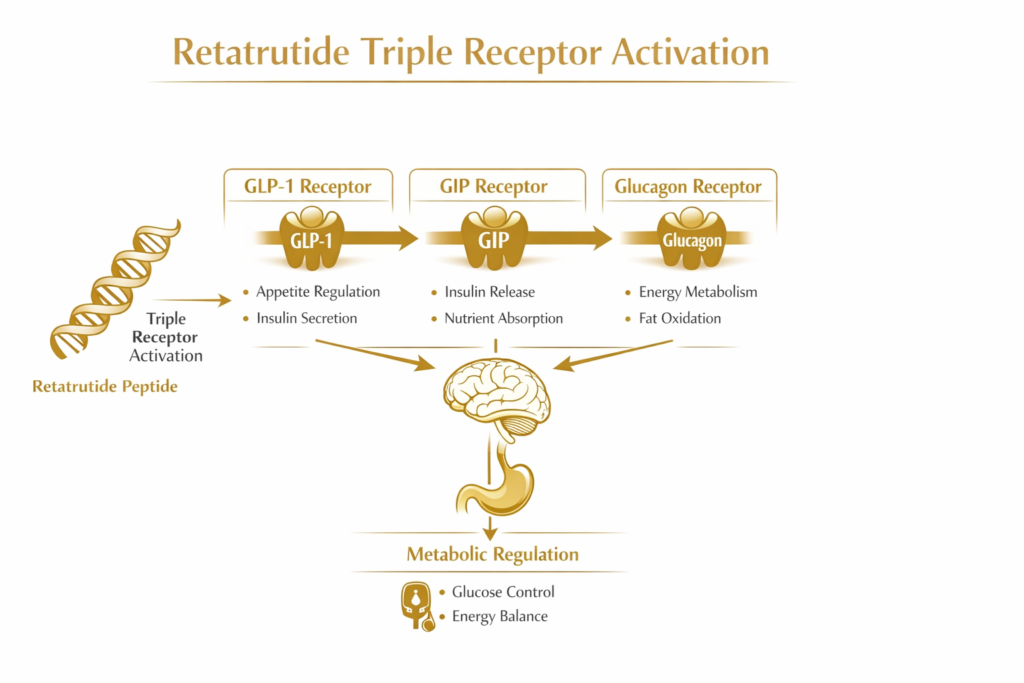
Unlike earlier peptides that focus on a single receptor, retatrutide is classified as a triple agonist peptide, meaning it activates three key receptors involved in metabolic regulation:
This multi-pathway signaling allows for a more coordinated metabolic response compared to single-pathway therapies. This is one of the main reasons retatrutide is frequently compared to other GLP-1–based therapies available in Mexico, such as semaglutide and tirzepatide, particularly by individuals evaluating the most effective peptide options for fat loss and metabolic improvement. To understand how peptide signaling differs from traditional hormone-based approaches, explore Peptides vs Hormones, where targeted signaling is compared to systemic endocrine effects.
Retatrutide works through receptor-mediated signaling across multiple organ systems, which is why it is often considered one of the most advanced metabolic peptides being researched by those exploring weight loss and performance-enhancing therapies in Mexico. This integrated signaling model is what separates it from earlier weight-loss compounds.
Research on triple agonist peptides highlights coordinated metabolic signaling across GLP-1, GIP, and glucagon pathways (https://pubmed.ncbi.nlm.nih.gov/37366315/).
This triple activation leads to several key physiological responses:
Because these pathways are interconnected, retatrutide allows researchers to observe how multiple systems work together to regulate metabolism rather than targeting a single mechanism in isolation.
For foundational understanding of incretin-based signaling, see GLP-1 Peptides in Mexico.
One of the most common questions people search is:
👉 “How much weight can you lose with retatrutide?”
Clinical data published in the New England Journal of Medicine shows that retatrutide can drive significant weight loss over 48 weeks, with high-dose groups achieving average reductions of over 20% of total body weight. These results are supported by sustained appetite suppression, improved insulin sensitivity, and measurable improvements in metabolic markers, positioning retatrutide as one of the most effective metabolic therapies currently under investigation.
Key clinical findings include:
These findings place retatrutide among the most promising compounds currently studied for obesity and metabolic dysfunction.
Unlike traditional dieting approaches, these effects are driven by biological signaling changes, not just caloric restriction, which is why interest in retatrutide continues to grow rapidly.
Beyond weight loss, retatrutide is being studied for its broader impact on metabolic health.
Additional studies have explored improvements in liver fat and metabolic markers in subjects with metabolic dysfunction (https://pmc.ncbi.nlm.nih.gov/articles/PMC12767911/).
This includes:
These findings highlight that retatrutide is not only a fat-loss peptide but also part of a broader metabolic optimization strategy.
👉 “Retatrutide dosage”
In clinical resarch settings, retatrutide is administered using a gradual titration protocol. This allows the body to adapt to the compound while minimizing side effects.
Typical research structure:
This gradual escalation is critical because retatrutide affects multiple metabolic pathways simultaneously, making controlled dosing essential for both safety and effectiveness.
One of the biggest risks with rapid fat loss is the loss of lean muscle mass.
Because retatrutide significantly reduces appetite and body weight, maintaining muscle becomes a key focus in advanced protocols.
For this reason, retatrutide is often evaluated alongside peptides that support recovery and growth hormone signaling:
This approach aligns with strategies discussed in Muscle Longevity in Mexico, where preserving muscle mass is critical for long-term metabolic health.
👉 “Retatrutide vs Ozempic”
The difference comes down to targeting:
This additional glucagon pathway is what may increase energy expenditure, making retatrutide more complex and potentially more effective.
Tirzepatide works on both GLP-1 and GIP pathways, making it more effective than GLP-1–only drugs like Ozempic. Retatrutide goes a step further by adding glucagon activation, potentially increasing energy expenditure and fat loss even more.
For those deciding what to use now, choosing between available treatments is critical:
For deeper analysis, see Retatrutide vs Tirzepatide. (availability, cost, effectiveness)
or
AOD-9604 as a more targeted fat-loss approach
👉 “Where to buy retatrutide in Mexico”
Because retatrutide is still in clinical development, direct access in Mexico remains limited through licensed medical providers. As a result, most individuals searching for retatrutide are either researching how it works, comparing it to currently available options like semaglutide or tirzepatide, or exploring peptide-focused clinics that offer alternative metabolic therapies.
For those looking to take action now, understanding which treatments are currently available—and how they compare in terms of effectiveness, cost, and safety—is often more practical than waiting for future approvals.
Because retatrutide is still under clinical research, choosing a reputable source is essential.
Because retatrutide is not yet widely accessible, most individuals ultimately move forward with clinically available alternatives such as tirzepatide or GLP-1–based therapies, depending on their goals, timeline, and budget.
For more information, see Peptide Sourcing in Mexico.
Explore your options:
Retatrutide is part of a broader category of peptides used for fat loss and metabolic regulation.
To explore the full category, visit:
👉 Weight Loss & Metabolic Peptides in Mexico
This includes:
These compounds target different aspects of metabolism, allowing for structured and personalized research approaches.
Retatrutide represents a significant shift in how metabolic health and fat loss are approached, combining multiple pathways into a single, coordinated mechanism. As research continues to evolve, it is likely to play a central role in the next generation of peptide-based therapies.