
loader image
0 $0.00
0 $0.00

Peptides vs Hormones in Mexico: Understanding Cellular Signaling and Optimization

Peptides and hormones are two of the most important biological signaling systems in the human body. While both act as messengers, they operate at different levels—hormones regulate the body systemically, while peptides deliver targeted, cell-specific instructions. Understanding this distinction is essential for anyone researching peptides in Mexico or exploring advanced strategies for metabolic health, recovery, and longevity.

Modern research highlights that peptides influence cellular communication, gene expression, and repair pathways, making them a central focus in regenerative and metabolic science (https://pubmed.ncbi.nlm.nih.gov/30206124/).

To understand the foundational role of these compounds, start with What Are Peptides in Mexico, where their biological function is explained in detail.


What Is the Difference Between Peptides and Hormones?

Hormones act as broad regulators of the body, controlling metabolism, mood, reproduction, and overall physiological balance. In contrast, peptides act as highly targeted signaling molecules, binding to specific receptors to trigger precise biological actions.

This difference allows peptides to influence cellular pathways such as repair, inflammation control, and metabolic signaling without the widespread systemic impact associated with hormone therapies. Research in endocrinology shows that peptides and hormones function as complementary layers of biological regulation rather than replacements for one another (https://pubmed.ncbi.nlm.nih.gov/26236730/).

For a deeper understanding of sourcing and regulatory context, review Peptide Sourcing in Mexico, which explains quality standards and access.

How Peptides and Hormones Work Together 

Rather than competing systems, peptides and hormones work together in a layered biological framework. Hormones establish the baseline environment of the body, while peptides fine-tune specific pathways within that environment.

For example, testosterone and estrogen influence systemic metabolism and tissue maintenance, while peptides such as CJC-1295 and Tesamorelin are studied for their role in supporting growth hormone signaling and downstream recovery pathways. Research demonstrates that growth hormone–related peptides can enhance endogenous hormone pulsatility and metabolic function (https://pubmed.ncbi.nlm.nih.gov/16352683/).

This combined approach is particularly relevant in areas such as:

  • metabolic optimization
  • recovery and tissue repair
  • hormonal balance during aging
  •  

Hormonal Health, Menopause, and Biological Decline

As the body ages, hormone levels decline—especially during menopause—impacting metabolism, energy, muscle mass, and overall health. Estrogen, progesterone, and testosterone play critical roles in maintaining baseline physiological function.

To better understand these changes, explore:

Research shows that declining hormone levels directly affect metabolic efficiency and muscle preservation, which are key predictors of long-term health outcomes (https://pubmed.ncbi.nlm.nih.gov/28585194/).

Within this context, hormone-based strategies such as:

are often studied for restoring baseline function, while peptides are explored for targeted signaling support.

Targeted Peptide Signaling for Specific Pathways


Peptides provide a level of precision that allows researchers to focus on specific biological pathways.

Hormonal & Sexual Health Signaling

Compounds such as PT-141 and Kisspeptin are studied for their role in central nervous system signaling and hormonal pathway modulation.

Growth Hormone & Recovery Signaling

Peptides such as CJC-1295 and Tesamorelin are explored for their influence on growth hormone release, recovery, and metabolic regulation.

Research highlights that peptide-based signaling can influence receptor activity and cellular adaptation without directly replacing hormones (https://pubmed.ncbi.nlm.nih.gov/37163881/).

For a broader view of peptide categories, explore:


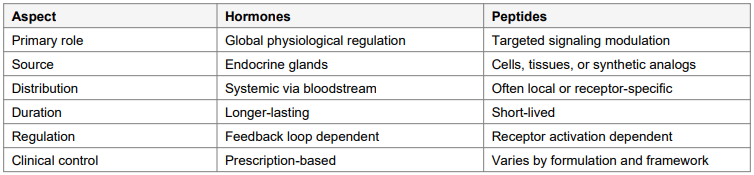
Key Structural and Functional Differences

Can You Replace Hormones with Peptides?

One of the most common questions is whether peptides can replace hormones. The answer is no—peptides and hormones serve different biological roles.

Hormones regulate baseline physiological states, while peptides influence how those states are expressed at the cellular level. Research indicates that peptide signaling often depends on a stable hormonal environment to function effectively (https://pubmed.ncbi.nlm.nih.gov/29505465/).

This is why peptides are typically studied as complementary tools rather than replacements.

How Peptides and Hormones Interact in the Body

Peptides and hormones represent two foundational classes of biological signaling molecules that coordinate physiological processes throughout the human body. While both participate in essential cellular communication, they differ meaningfully in their molecular structure, signaling scope, regulatory behavior, and biological persistence.


Modern research across endocrinology, molecular biology, and regenerative science examines peptides and hormones as interacting layers of biological control. Understanding where each fit, allows for a more precise interpretation of research findings, metabolic therapies, and regulatory frameworks. For example, certain peptides involved in growth hormone signaling are studied for their ability to influence endogenous hormone pulsatility rather than replace hormone production outright. This layered interaction underscores the complementary nature of peptide and hormone systems.
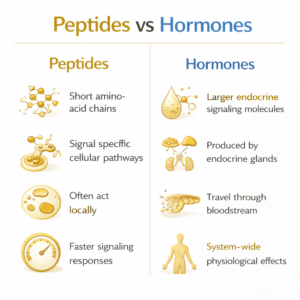
peptides vs hormones biological comparison on diagram showing receptor signaling pathways in the human body.

Why Peptides and Hormones Are Sometimes Used Together in Research

In clinical and research contexts, peptides and hormones may be studied together because they address different layers of biological signaling. Hormones establish broad systemic conditions, while peptides fine-tune specific pathways within that hormonal environment.

For example, when baseline hormone levels are insufficient to support normal physiological function, hormone replacement may restore foundational signaling. Peptides may then be studied for their ability to modulate downstream pathways, receptor sensitivity, or tissue-level responses within that restored hormonal framework.

This approach reflects a systems-based understanding of biology, where global regulation and local modulation work together rather than in opposition. Importantly, educational discussion of combined peptide and hormone use does not imply medical necessity, endorsement, or universal applicability.

Why Peptides Are Not a Substitute for Hormones

Despite overlapping roles in biological communication, peptides generally do not replace hormones in a clinical sense. Hormones govern baseline physiological states, while peptides influence how those states are expressed at the cellular or tissue level.

For example, if baseline hormone levels are severely depleted, researchers observe that peptide signaling often lacks the necessary foundational environment to operate optimally. Attempting to substitute peptides for hormones ignores the distinct regulatory architecture of endocrine systems.

Understanding how the body responds to targeted peptide research requires first looking at this biological foundation. As the body ages—particularly during the menopausal transition—the natural decline of foundational hormones like estrogen and testosterone fundamentally alters systemic metabolism and cellular repair. To explore how restoring this baseline is a critical first step before introducing targeted metabolic signaling, read our deep dive into [Menopause and Hormone Health: Restoring the Biological Baseline].

One of the most severe consequences of this systemic hormonal shift is the rapid, age-related loss of skeletal muscle, a condition known as sarcopenia. Because muscle acts as the body’s primary metabolic engine and glucose sink, preserving it is the ultimate key to extending health span and metabolic efficiency. Discover why protecting this vital tissue is at the forefront of modern peptide and secretagogue research in our comprehensive guide, [Longevity and Strength: Why Muscle Matters for Aging].


Where to Buy Peptides in Mexico

Many people search for where to buy peptides in Mexico, but the more important factor is understanding sourcing, quality, and regulatory structure.

Rather than focusing only on availability, it is essential to understand:

  • purity and consistency
  • handling and storage
  • supplier reliability

To learn how peptides are accessed within structured frameworks, review:
👉 Peptide Sourcing in Mexico

You can also explore the full system through the
👉 Peptide Education Hub

Peptides and Hormones as a Combined System

Peptides and hormones represent two layers of biological control—systemic and targeted. Understanding how they work together allows for a more precise approach to metabolism, recovery, hormonal balance, and long-term health.

Rather than choosing one over the other, modern research focuses on how these systems interact to optimize performance and biological function.

To continue exploring this topic, return to the
👉 Peptide Education Hub

Explore Peptide Categories

Professionally sourced peptides with an emphasis on quality, documentation, and responsible handling. 

Frequently Asked Questions

Are peptides the same as steroids?

No. Peptides are short chains of amino acids that act as signaling molecules, while steroids are hormones that affect the body systemically.

No. Peptides and hormones serve different roles. Hormones regulate baseline biological function, while peptides provide targeted cellular signaling.

Peptides bind to receptors on cells and send signals that regulate processes such as metabolism, recovery, and inflammation.

Peptides in Mexico are typically accessed through providers that follow quality, sourcing, and regulatory standards. It is important to understand how peptides are sourced and handled rather than focusing only on availability.

👉 Are Peptides Available in Mexico? Legal Guide & Purity | Myosfit

Filter by Categorías de productos
    0
    Su Carrito
    Su Carrito está vacíoRegresar a Comprar
      Calculate Shipping

      MyosFit Presents a Live Peptide Education Event For People Who Want the Truth Behind Peptide Science.

      Inside This Event:

      What peptides really are and how they function inside the body
      The logic and structure behind high-performance MyosFit stacks
      Fat loss, muscle recovery, sleep, longevity, and skin optimization strategies
      How advanced stacks are engineered, not guessed
      What defines clinical-grade peptides,s and why most products fail that standard

      The date has not been announced yet – join the early interest list to be notified first when registration opens.

      Let's have a chat

      Subscribe Now

      Signup for news and special offers!​